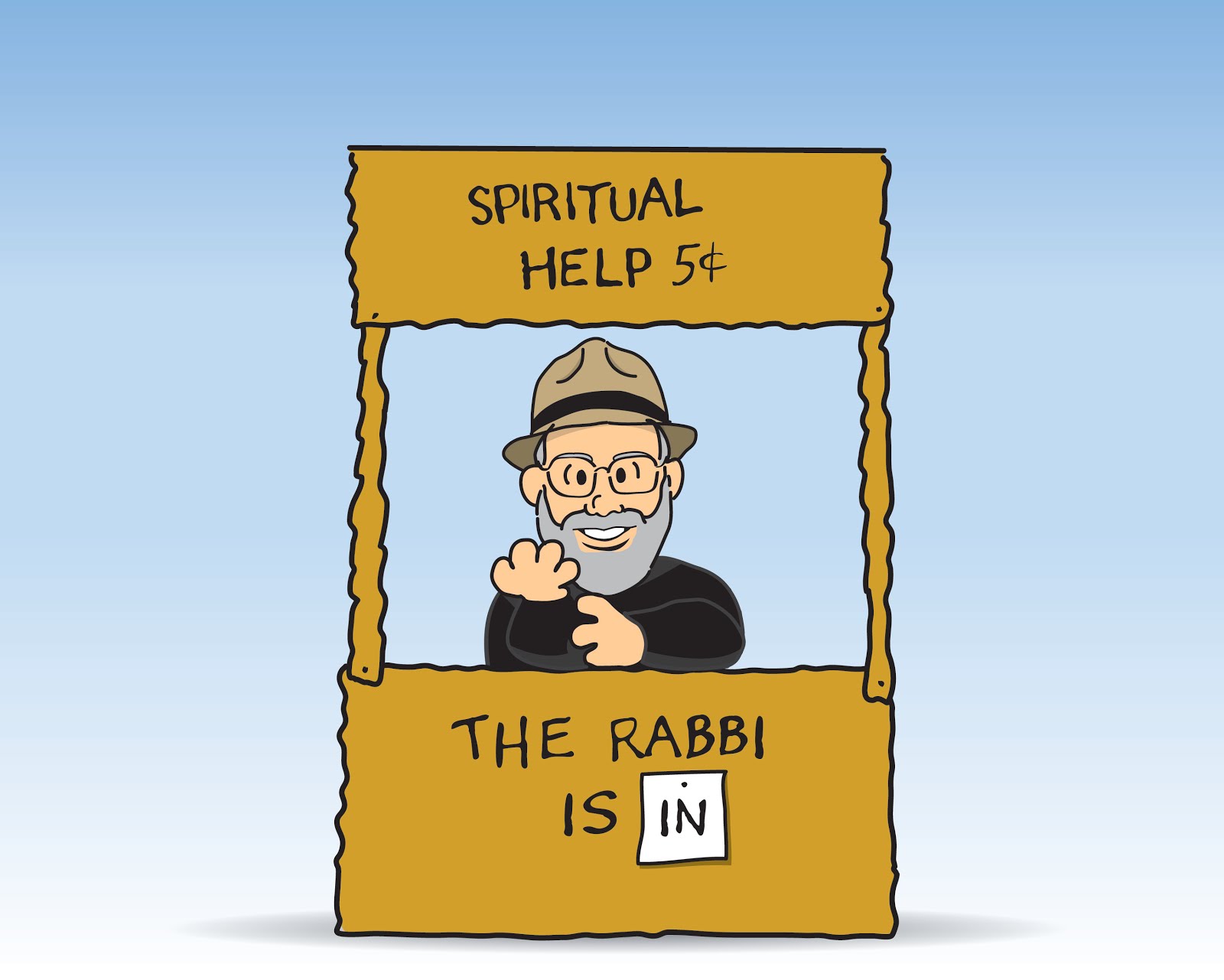
How do fortunetellers make money? I notice Palm Reader shops in high rent areas, and I never see lines of people waiting to get in. So how do they manage?
I ask this because I have to find a job this year. Adjunct teaching is fun but not financially rewarding. Writing books, blogs, and magazine columns is even more fun, but only slightly more financially rewarding. So I need to find a job.
I went to a temp company, but they had no idea how to place a guy whose only skill is public speaking and Torah commentary. Of course I could look for a rabbinic position, but I want something more satisfying than pretending that Judaism has anything of spiritual value to offer twelve-year-old kids and their harried parents. A local church offered me a job, and I admit to being tempted by the chance to damn to hell people who disagree with me, but in the end I have decided on fortunetelling.
Not astrology, mind you, that’s too hard. You actually have to be able to make and read charts, and, to be honest, I can’t remember all twelve Zodiac signs. Tarot Card reading is out as well. If I can remember twelve Sun Signs, there is no way I can recall the meanings of the 22 Major Arcana. Palm reading, too, isn’t for me, since I don’t like the idea of having to touch people’s palms. Who knows where they have been?
No, my plan is to use a proven fortunetelling tool that has been with me for over half a century: The Magic Eight Ball. I trust the Ball. You can ask it anything, and it always answers.
To prepare for my new career, I spent New Year’s Day asking deep personal questions of my round Seer.
“Will I loose this year the fifty pounds that I failed to lose last year?” OUTLOOK NOT SO GOOD. “Will I have to work hard to make ends meet this year?” AS I SEE IT, YES. “Will this be the year that I stop hurting people I love?” DON’T COUNT ON IT. “Will this year find me finally changing the way I live and think so that I can at last do both with true serenity and integrity? MY SOURCES SAY NO. AND WHILE WE ARE ON THE SUBJECT YOU ARE A REAL BUTTHEAD.
See: it never fails. So I have the tool for my trade, now I just have to figure our how to ply it. Maybe I should rent space in the town square. MY REPLY IS NO. Or maybe I should set up a roadside stand. VERY DOUBTFUL. Hey, I’m not even asking the Ball these questions. WITHOUT A DOUBT. Then who is feeding me these answers? BETTER NOT TELL YOU NOW. This is weird. IT IS DECIDEDLY SO. OK, knock it off. MY REPLY IS NO. All right, fine.
Anyway, I think people will go for this. I will charge five dollars for an answer, and another ten to explain the answer. And if I have no idea what my client is talking about— REPLY HAZY. TRY AGAIN. That’ll be five dollars, please.
Monday, May 12, 2008
Behind the Eight Ball
Thursday, May 08, 2008
"Evangelical" Defined
For many the word “evangelical” is a fighting word. Depending on your personal beliefs “evangelical” means standing for the truth or standing for narrow-mindedness and bigotry. It really means neither.
Evangelical is an adjective used to describe someone who propagates the Good News of Jesus Christ. In and of itself the term is somewhat neutral, though over the past decades it has been associated with the right wing of the Republican Party. An evangelical Christian, which is really an oxymoron given that all Christians are charged with spreading the Gospel, may or may not be in favor of abortion, capital punishment, evolution, deregulated capitalism, the Rapture, or dancing. Yet the word continues to be used as if it told us something.
To help correct matters some, the Evangelical Theological Society has issued an evangelical manifesto that requires those who label themselves evangelical to adhere to two principles: the inerrancy of Scripture, and belief in the triune God of Father, Son, and Holy Spirit as “separate but equal in attributes and glory” and essential for salvation. Now evangelicals can vote Democratic and dance at the inauguration balls. Good for them!
But I am now more troubled than before. I know that most evangelicals accepted the idea that the Bible was without error. Most of my Bible students at Middle Tennessee State come into my class with this belief, and, much to my dismay, leave with it intact as well. But I didn’t know that the Trinity required a belief in a separate but equal clause; the key word being “separate.” If Father, Son, and Holy Spirit are separate then they are distinct, they are three not one, and hence evangelicals are polytheists. That surprised me.
To look deeper, I checked the Catholic Encyclopedia and learned that according to the Athanasian Creed: "the Father is God, the Son is God, and the Holy Spirit is God, and yet there are not three Gods but one God." Obviously someone can’t count. Each of the three Persons of the Trinity is co-eternal and co-equal: all alike are uncreated and omnipotent. Which means, despite creedal assurances otherwise, that there are three Gods. You can’t be co-anything if you are the same thing. So I stand corrected. I thought the charge of Christian polytheism was a slur, but now I don't think so. I think they do believe in three gods, but have found it politically inexpedient to just come out and say so.
Now I have no problem with people believing what they like. I stand with Tom Jefferson on this, “It does me no injury for my neighbor to say there are twenty gods or no God. It neither picks my pocket nor breaks my leg. (Notes on Virginia, 1782). Believe what you like, but be honest about it. If you believe in three Gods, say so, but don’t pretend that you really believe in one God.
The Hindus have their trinity: Brahma, Vishnu, and Shiva but say they these gods are attributes of the One God Brahman and not three co-equal deities. And the Hindu Rig Veda, the oldest scripture in the world says, “Truth is One, different people call it by different names.” This is my understanding as well, but it isn't the evangelical or Catholic position. I just find it fascinating that in the 21st Century people still believe in multiple gods. But then I am still amazed that you get two scoops of raisins in every box of Post Raisin Bran. Every box!
Friday, May 02, 2008
Are You A Harley Man?
Forever in pursuit of deeply accurate and meaningful categories in which to pigeonhole people, I am now prepared to argue that there are only two kinds of American men: Harley Men and Vespa Men. I am a Vespa Man suffering from Harley-envy. Worse still, I’m a Vespa Man without a Vespa. Where is Dr. Freud when you need him?
Now before you go ballistic on me for reducing all men to their wheels, New Scientist magazine, reports on a study of male rhesus monkeys (these are monkeys made from a mixture of chocolate and peanut butter for you scientifically challenged readers) who, when given a choice between playing with dolls or trucks, ignore the dolls and choose the trucks every time. Darwin rules! Men are evolutionarily designed for motorized locomotion. If that doesn’t prove Intelligent Design nothing does.
The problem with my peanut butter filled primate cousins is that they cannot distinguish between cool wheels, i.e. a Harley Davidson motorcycle, and metrosexual wheels such as a Vespa. I, on the other hand, can and do.
I have ridden a Harley once and sat on one twice. When I was a student at Tel Aviv University I had a friend who looked like the rock star Meatloaf and who owned a Harley. I would sit behind him, my arms wrapped tightly around his ample middle, as we sped through the streets of the not-so-holy city. I think he would have preferred it if the person pressed against him was wearing a miniskirt or bikini but I refused.
My second Harley experience was at the Jewish Community Center in South Miami-Dade when I sat on the bike of a friend. Unaccustomed to being in the driver’s seat I pressed a bare leg (I was wearing gym shorts not a bikini) against the hot muffler and burned myself badly. If only there had been a dragon embossed on the side of that muffler I would have had a cool tattoo ala Kwai Chang Kane, but, just my luck, there was only a welt. It was then, I suspect, that I knew I was a Vespa Man.
Why am I bringing this up today? Because yesterday I read a full page Harley-Davidson ad in USA TODAY: We don’t do fear. Over the last 105 years in the saddle, we’ve seen wars, conflicts, depression, recession, resistance, and revolutions. We’ve watched a thousand hand-wringing pundits disappear in our rear-view mirror. But every time this country has come out stronger than before. Because chrome and asphalt put distance between you and whatever the world can throw at you. Freedom and wind outlast hard times. And the rumble of an engine drowns out all the spin on the evening news. If 105 years have proved one thing, it’s that fear sucks and it doesn’t last long. So screw it, let’s ride.
Yeah! Let’s ride! I said, LET”S RIDE! CAN YOU HEAR ME? I HAVE TO SCREAM OVER THE SOUND OF MY EN… Oh, yeah. Vespa Man. I’m riding a scooter that whines rather than roars. And while those Harley Men are racing away from whatever it is those other men are throwing at us, I keep getting hit in the back of the head.
Actually it’s worse than that. I can’t afford a Vespa, so I’m walking. It is easy to throw stuff at a guy whose walking. I move at about 3.8 MPH, and I go from 0 to 60 in about, well, never. I guess I will just have to make my peace with fear.
Thursday, May 01, 2008
Tossing and Turning: the Insanity of Religion
Do you think religion makes people do weird things? I don’t. I think people make religion do weird things. People invent religion to excuse weird behavior that they want to do, but that they need some excuse for doing. They know what they want to do is insane, but they want to do it anyway, so they invent a god who will punish them for all eternity if they don’t do it. It gives them the perfect cover.
Take for example the Jewish custom of kaparot (kapores where I come from): turning a rooster or a hen over your head (a rooster is you are male, a hen if you are female) during the High Holy Day period and believing that by doing so your sins are passed to the bird and that by slaying the bird you are free from those sins. God so loved the world that He gave His only begotten chicken to die for our sins? Does this make sense to you? Is this the best my ancestors could come up with when they sought to borrow from their Christian neighbors?
I can imagine a bunch of rabbis gathering in a shul saying, “Look we’ve got to modernize to fit in. We have to be more goyish. The Christians believe Jesus died for their sins, why don’t we run with that. They’ll appreciate the sentiment. Say, I have an idea, instead of Jesus, why not go with a chicken?”
This kind of magic is ridiculous. But, if you don’t really care about the welfare of chickens, quite fun. You take this bird squawking and screaming, grab it by its feet and spin it around your head like you were a finalist on Dancing with the Stars or representing Israel in the Winter Olympics ice skating competition. I’ve seen this done, though not on Dancing with the Stars or at the Winter Olympics. No, I’ve seen it done in Israel. And in Haiti. In Israel it is called Judaism. In Haiti it is called Voodoo.
And then there is baby tossing. Indian Muslims at the Shrine of Solapur have for the past five hundred years dropped their infants from a fifty-foot tower into a taught sheet held by the faithful many feet below. In this way God will bless the baby either with a long and healthy life, or a very short one lasting no more than the time it takes to hit the ground after having been tossed from a fifty-foot tower. Maybe these Muslims read Nietzsche, “What doesn’t kill me makes me stronger.”
Rooster swinging and baby tossing. No wonder Christopher Hitchens is angry. Religious people are insane.
And then there is the Rev. Jeremiah Wright. The man is angry about American Indian genocide, the enslavement of millions of Africans, Jim Crow laws, lynching, the interment of Japanese Americans during World War II, Vietnam, the treatment of blacks in South Africa during Apartheid, the treatment of Palestinians by Israel, and the fact that Barack Obama dissed him on national television. I mean get over it. What if we Jews kept harping about the destruction of the Temple, or our problems with ancient Egypt, Persia, and Rome, or our expulsion from Spain, or the Crusades, or the Holocaust, or the fact that classic Star Trek with two Jewish leading men got cancelled while the oh so goyish Capt Picard gets to fly where nobody has gone before for longer than the guys who did it first? People would think we are just using history to promote our own agenda.
But maybe you think there is a difference between the prophetic call for justice and the killing of a chicken to ransom you from your sins. Maybe you think decrying slavery then and racism now is somehow more righteous than tossing your six-month-old off the top of a tower. Maybe you think. But if you do you probably aren’t among the truly faithful.
Monday, April 21, 2008
To Press or Not to Press, Is This the Question?
Do you have free will? Now before you answer, think about this:
If you don’t have free will and you answer, “Yes, I do have free will,” why are you programmed to lie to yourself regarding free will?
On the other hand if you do have free will and you answer, “No, I don’t have free will,” why are you so mistaken about something that is so essential to your every action?
A new study on the brain has proven (yet again) that a person’s decision whether or not to press a button can be detected up to seven seconds before the person herself realizes she has made a decision. Get that? By the time you say to yourself, “OK, I am going to press that button” your brain has already decided the matter. Your self-talk about decision making is a delusion. You, and by “you” I mean the “you” that says, “OK, I am going to press that button” is simply a puppet responding to a decision made without you in your brain!
When I first read this I was troubled. I want to believe I have free will, but I am a science oriented person so if a scientist tells me otherwise who am I to disagree? Then I looked into this experiment a bit more deeply and realized that the only thing this test proves is that I have no free will when it comes to pressing buttons.
I spent the next day at home counting how many buttons I press (as opposed to switches I flip, levers I pull, dials I turn, etc.). Not counting the keys on my Powerbook G4 the number came to two: the button that starts my blender that makes my fruit drink in the morning, and the button that starts my toothbrush that cleans my teeth after I have had my fruit drink in the morning. I press the toothbrush button twice a day, the blender button once. Had I not spent the whole day indoors counting buttons, I might have taken my car somewhere and then I would have pressed a lot more buttons on my radio, cd player and air-conditioner, but I decided not to go out and to stay in counting buttons.
Or did I?
Maybe the test has implications beyond buttons. Maybe I decided to type that last sentence seven seconds before I actually typed it. Maybe I, the “I” that takes credit for whatever the brain has decided seven seconds before the “I” that takes credit for it even knows a decision has been made, is just commenting on decisions made by someone else, the real me, the real me that I have never met or known, because the only me I know is the seven-second-delay me who is really nothing much at all. I am simply an afterthought.
This idea is somewhat exciting. As an afterthought I am always surprised: What will that crazy ol’ brain of mine decide to do next? It could be anything. I have no idea. How about this: Let’s wait seven seconds to see what
Friday, April 18, 2008
New Questions for Passover
USA TODAY ran a lengthy front page article on the ways different people touched by the horror of 9/11 are dealing with their faith (April 18-20, 2008). Some found God through the attack, others lost God because of it. At the heart of the article is the question, “Where was God on 9/11?”
There were the expected answers: God was with the victims; He was with the mourners; He was with the rescuers. But the one answer that I wanted to hear, the one that we must hear, and the one that was missing was this, “God was flying those planes into the Towers, the Pentagon, and the ground.”
The terrorists were people of faith. They were prayerful men of God carrying out His Will. True, I think they were evil and their god a projection of that evil, but I do not question the authenticity of their faith. According to them, it was God who told them to kill thousands of Americans, and I have no way of proving them wrong.
I mentioned this to a rabbi friend the other day and he said, “God protects the innocent. The way you know God is God is that He protects the powerless.”
I wish it were so, but here we are on the eve of Passover when millions of Jews around the world are going to celebrate God’s torment and murder of thousands of innocents! The Torah is filled with God sanctioned violence and acts of genocide. If that was God’s Will then, how can I be certain that it isn’t God’s Will now? Is the best I can say is that the true God wouldn't target me and mine? That too is disproved by the Torah where God is more than happy to wipe tens of thousands of Israelites whenever they displease Him.
Believing in God is dangerous business.
I am not demeaning the faith or lack of faith of the people mentioned in the article. I am only suggesting that a deeper discussion is necessary. For me, no religion whose god sanctions violence is true. Judaism included.
The terrorists worshipped their own projections, feeding their own egos, excusing and sanctioning their own madness and murderous rage. There are passages of Torah that do the same. The only difference is who is doing the killing. Can it be that the Israelites who heard God command them to exterminate Amalek or the inhabitants of Jericho were right, while the Moslems who hear God command them to exterminate their enemies are wrong? Or is right and wrong simply the byproduct of who is claiming to hear what from Whom? This is a crucial question on the eve of Passover.
Tomorrow night we Jews are going to celebrate a destruction no less horrifying to the ancient Egyptians than the Twin Towers attack is horrifying to modern Americans. I can't do this any more. I know we want to say it isn't the same; I know we want to say our God is good and true, and their god is evil and false, but our story does not bear this out.
So this Passover I will ask four new questions and invite you to do the same:
1. Why on this night do we celebrate the slaughter of innocents when on all other nights we decry it?
2. Why on this night do we link ourselves to a murderous god, when on all other nights we are horrified by others who do the same?
3. Why on this night do we read this nightmare of liberation and pretend that doing so doesn’t continue the jihadist mentality that plagues all three Abrahamic faiths?
4. Why on this night do we spill a little wine from our cups so as not to rejoice at the suffering of others when we should refuse to drink at all, saying to God and to ourselves, “Enough! You stamp out the righteous along with the wicked! It is a sacrilege to You! Shall the Judge of all the earth not do justice?” (from Genesis 18:23-25).
Chag Sameach Pesach!
Sunday, April 06, 2008
Going to the Dogs
Do pets go to heaven? According to Gary Kurtz in Cold Noses at the Pearly-Gates the answer is yes. I’m not so sure, and would like to pose three questions of Gary:
1. Do animals have souls?
2. Does my pet have to believe in Jesus as Christ to enter heaven?
3. If so, how can my pet achieve this faith; or if not, how is it that God is more generous to an unbelieving beagle than He is to an unbelieving human?
Let’s take up each question in turn.
Do animals have souls? The Buddhist variant of this question, Does a dog have Buddhanature, is the first koan given to most students of Rinzai Zen. The answer is Mu! which means No! or Nothing, but which is better translated as Stop asking stupid questions and wake up from the delusion that plagues your life right now!
I tend to side with the Buddhists. I don’t believe in souls. To me souls are just projections of the ego refusing to admit to its own annihilation at death. Souls perpetuate the delusion that you are separate from the One Who is all.
Do animals have to believe in Jesus to get to heaven? No, there is no heaven. Heaven is not a place you go to; heaven is the place you are right now if you would wake up to the true nature of reality and act accordingly. When you know all beings are God you engage all life with godliness. That is heaven. Hell is everything else.
Is God more generous to animals than humans? No, God manifests as both. True, I’d rather be a human than a dog, and a dog than a cat (I’ll get hate mail for that revelation), but each of these is fully God just as every wave is fully the ocean in which it arises.
Of course by denying souls and heaven I’m really avoiding the questions rather than answering them. So it seems to me that if there were souls and animals had them they would have to be held to the same entry standard as humans: Jewish dogs are out, Baptists dogs are in. My neighbor has a great dog and they are Jehovah’s Witness. Will Rusty make it to heaven or not? Is it his fault that his doghouse gets a subscription to Watchtower magazine?
Chuck Colson in the April 08 issue of Christianity Today says Kurtz is wrong and animals do not have souls or an afterlife. While Pastor Colson acknowledges that this may be harsh news to the followers of the Good News, he is adamant that we realize that only humans have souls, for to do otherwise would require us to grant the same rights to animals that we grant to people.
By arguing that only humans have souls, Christians “can make a logical defense of the uniqueness of human life. But if out of sentimentality we treat our pets as if they have souls, we give away the argument. What a tragic irony if the church finds it has been conquered on behalf of our beloved pets.”
I am not sure what the irony is, but I would agree that if we aren't vigilant all religion, and not just Christianity, is going to the dogs.